Dear friends of modern allegorical drawing!
It’s actually wonderful that linear time exists!
It’s the only way we can experience development. It’s the only way the evolution of forms and consciousness can take place at all!
According to Albert Einstein, however, linear, flowing time is nothing more than a ‘persistent illusion’. Time is relative. It combines with space to form a fourth dimension: spacetime.
The past, present and future can exist simultaneously in a higher-dimensional reality.
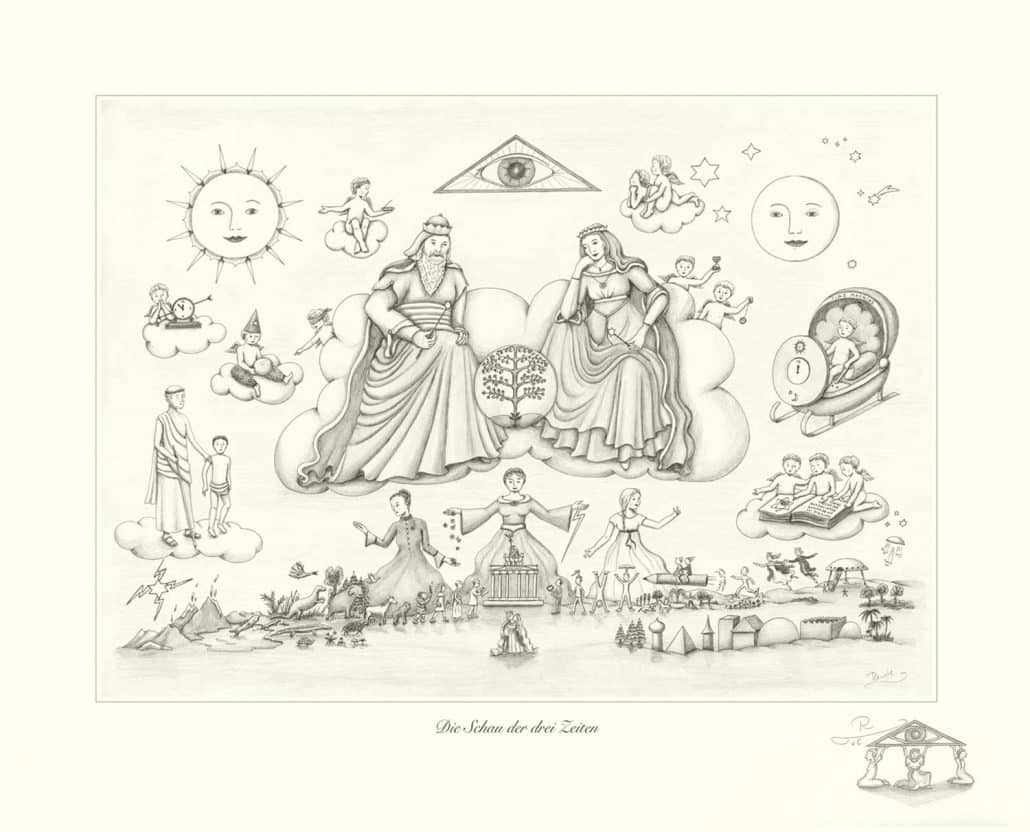
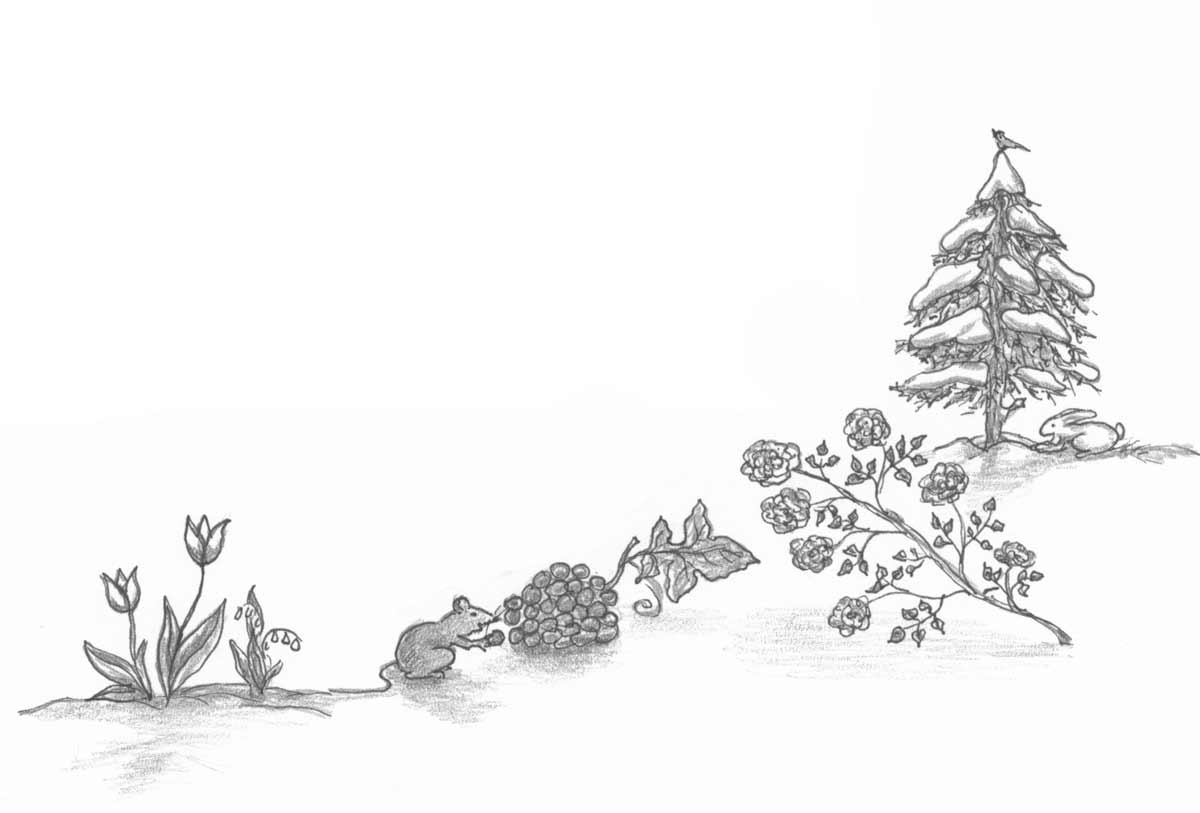
Contemplation of the Three Times
Hand-signed art print with a small original drawing, (500 x 620 mm)
The ancient sages of India and some eminent Western philosophers also viewed ‘our’ linear conception of time merely as a state of consciousness that can be transcended in order to attain a higher, more comprehensive perspective.
In the 15th century, Nicholas of Cusa (Cusanus) spoke of the convergence of opposites (in this context, the past and the future), and in ancient India there was the concept of trikaladrsti, the so-called vision of the three times, in which the past, present and future unite in a transcendent, blissful state.
It’s good to know that such a level of consciousness exists and can even be experienced!
At the very least, I can try to focus on it mentally when I sometimes find myself too caught up in the ‘grip of time’. I don’t want to blindly chase after the ever-hopping rabbit, bound by time and its deadlines, like Alice in Wonderland!
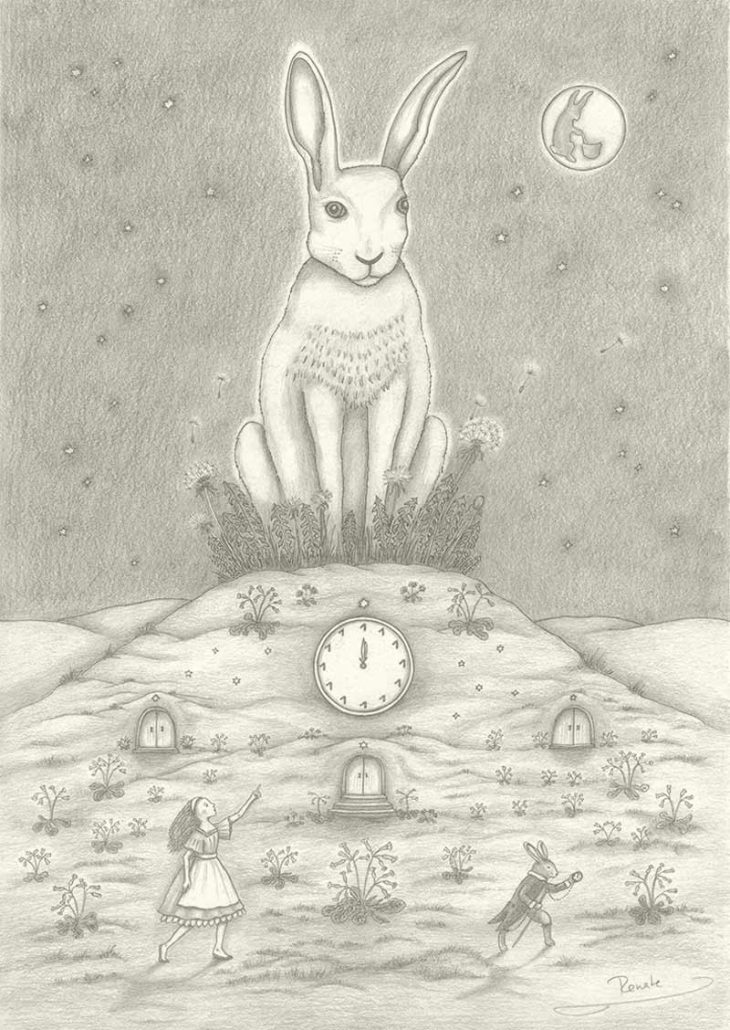
The Wise Hare and Alice
Original, 420 x 297 mm
Fortunately, in my picture, Alice spots the great, wise hare, who has a broader perspective on things and sits quite calmly, untroubled by time, enthroned on the Hill of the Three Times.
And whenever he feels like having an adventure or taking part in the unfolding of events, he opens one of the three doors of time and steps into the era of his choice, yet he is always aware of his rightful place at the top of the hill.
I wish us all a place like that, above the turbulence of the times!

More posts from the series ‘Contemplations’: